
Navigating the complexities of the XNXNXNXN cube demands a strategic approach, often relying on documented algorithms – like those found in PDF guides – to efficiently solve this challenging puzzle.
What is an XNXNXNXN Cube?
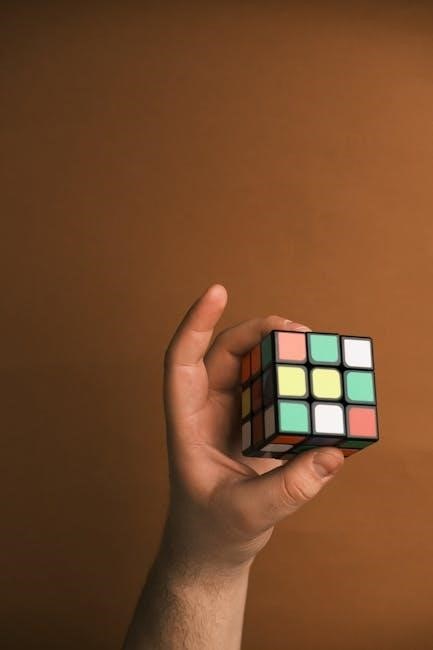
The XNXNXNXN cube, often referred to as the Rubik’s Revenge, represents a significant leap in complexity beyond the standard 3×3 Rubik’s Cube. It features six sides, each with nine squares, resulting in a total of 81 squares. This larger size dramatically increases the number of possible permutations, making intuitive solving nearly impossible.
Consequently, mastering this puzzle necessitates learning a set of algorithms – pre-defined sequences of moves – designed to manipulate specific pieces without disrupting others. Resources like PDF guides detailing these algorithms are crucial for anyone attempting to solve the XNXNXNXN cube efficiently. These guides often categorize algorithms based on the specific task they perform, such as orienting corners or permuting edges.
Why Learn Algorithms?
Attempting to solve an XNXNXNXN cube without algorithms is akin to navigating a labyrinth blindfolded – incredibly difficult and time-consuming. The sheer number of possible configurations (over 43 quintillion!) renders brute-force methods impractical. Algorithms provide a systematic, efficient pathway to a solution, breaking down the complex task into manageable steps.
PDF guides containing these algorithms are invaluable tools. They offer a structured learning approach, categorizing moves for specific scenarios. Understanding algorithms isn’t just about memorization; it’s about grasping the underlying principles of cube manipulation. This knowledge empowers solvers to adapt and even create their own solutions, ultimately enhancing their cubing skills and speed.
Understanding Cube Notation
Decoding XNXNXNXN cube algorithms requires familiarity with standard notation (F, B, R, L, U, D) and potentially wide moves, detailed in PDF resources.
Standard Notation (F, B, R, L, U, D)
Mastering standard cube notation is fundamental when learning XNXNXNXN cube algorithms, often detailed in PDF guides. ‘F’ represents the Front face, ‘B’ the Back, ‘R’ the Right, ‘L’ the Left, ‘U’ the Up, and ‘D’ the Down face. A letter alone signifies a clockwise 90-degree turn. Adding an apostrophe (‘) denotes a counter-clockwise turn. A ‘2’ after a letter indicates a 180-degree turn.
Understanding these basic moves is crucial for interpreting and executing complex algorithms found in resources like XNXNXNXN cube algorithms PDFs. These PDFs frequently utilize this notation to clearly communicate the sequence of turns needed to manipulate the cube’s pieces, enabling solvers to efficiently progress through each step of the solving process.
Wide Moves (Fw, Bw, Rw, Lw, Uw, Dw)
For the XNXNXNXN cube, standard notation expands to include ‘wide moves’ – essential for many algorithms detailed in PDF guides. These moves affect two layers simultaneously. ‘Fw’ turns the Front two layers, ‘Bw’ the Back two, ‘Rw’ the Right two, ‘Lw’ the Left two, ‘Uw’ the Up two, and ‘Dw’ the Down two.
Like standard notation, an apostrophe (‘) reverses the direction, and ‘2’ signifies a 180-degree turn. XNXNXNXN cube algorithms PDFs heavily rely on wide move notation to efficiently manipulate larger sections of the cube. Recognizing and accurately executing these moves is vital for solving, as they often form the core of parity correction and final layer permutation steps.
Layer Notation for XNXNXNXN Cubes
Understanding layer notation is crucial when referencing XNXNXNXN cube algorithms found in PDF resources. Beyond the standard six faces (F, B, R, L, U, D), the 4x4x4 and larger cubes introduce inner layer designations. These are often represented numerically or with additional letters. For example, ‘R’ refers to the outer right layer, while ‘r’ might denote the inner right layer.
PDF guides frequently utilize this extended notation to precisely define moves affecting specific layers. Mastering this system allows for accurate execution of complex algorithms. Correctly interpreting layer notation is paramount for successful solving, especially when dealing with parity errors or advanced techniques detailed within comprehensive XNXNXNXN cube solution manuals.

Basic Algorithms for XNXNXNXN Cubes
Essential algorithms, often detailed in XNXNXNXN cube PDF guides, focus on corner and edge orientation, forming the foundation for solving this complex puzzle efficiently.
Corner Orientation Algorithms
Mastering corner orientation is crucial for XNXNXNXN cube solving, and numerous PDF resources detail specific algorithms to achieve this. These algorithms manipulate corner pieces without altering their positions, focusing solely on twisting them into the correct orientation. Often, these involve sequences of wide and layer moves, carefully designed to affect only the targeted corners.
PDF guides frequently present algorithms for cases where one, two, or even all corners require re-orientation. Understanding the impact of each move is vital; reversing an algorithm returns the cube to its prior state. Symmetric algorithms, as described in some resources, offer alternative solutions by reversing the manipulation direction. Successfully applying these algorithms builds a solid foundation for tackling more complex stages of the solve.
Edge Orientation Algorithms
Edge orientation, like corner orientation, relies on specific algorithms detailed in XNXNXNXN cube PDF guides. These algorithms focus on twisting edge pieces into their correct positions without changing their location within the cube. They often involve sequences of layer and wide moves, strategically chosen to impact only the edges needing adjustment.
PDF resources categorize algorithms based on the number of misoriented edges – one, two, or more. Recognizing these cases is key to applying the correct solution. Remember, reversing an algorithm undoes its effect, allowing for experimentation and understanding. Symmetric algorithms, mirroring the approach for corners, provide alternative solutions. Mastering edge orientation is a significant step towards completing the XNXNXNXN cube.

Solving the First Layer
Initial steps, detailed in XNXNXNXN cube PDF guides, involve creating a cross and inserting corners, establishing a solid foundation for subsequent layers and algorithms.
Cross Solution on the First Layer
Building the cross on the first layer of an XNXNXNXN cube, as detailed in numerous PDF algorithm resources, requires careful planning and execution. Unlike smaller cubes, the larger size introduces complexity, demanding a systematic approach to piece placement. PDF guides often illustrate intuitive methods for bringing edge pieces into position, focusing on minimizing disruptions to already solved sections.
Understanding the impact of each move is crucial; a single incorrect turn can necessitate significant rework. Many tutorials emphasize recognizing patterns and utilizing algorithms designed to efficiently maneuver edge pieces without disturbing others. These resources frequently showcase visual aids, breaking down the process into manageable steps, making the cross solution accessible even for beginners tackling this larger puzzle;
First Layer Corner Insertion
Inserting the corners of the first layer on an XNXNXNXN cube, as outlined in many XNXNXNXN cube algorithms PDF guides, presents a unique challenge due to the cube’s size. These resources typically detail algorithms focused on correctly positioning and orienting each corner piece without disrupting the established cross. PDFs often emphasize recognizing the corner’s current location and orientation to select the appropriate algorithm.
Effective corner insertion relies on understanding how algorithms manipulate multiple layers simultaneously. Tutorials frequently demonstrate techniques to ‘cycle’ corners into their correct slots, utilizing sequences of moves that preserve the solved cross while achieving the desired corner placement. Mastering these algorithms, readily available in PDF format, is fundamental to efficiently completing the first layer.

Solving the Second Layer
XNXNXNXN cube PDFs detail algorithms for inserting second-layer edges, focusing on recognizing cases and applying specific move sequences to achieve correct positioning.
Second Layer Edge Insertion Algorithms
PDF guides dedicated to XNXNXNXN cube solving extensively cover algorithms for second-layer edge insertion. These resources typically present multiple algorithms, categorized by the initial position and orientation of the edge piece you’re attempting to insert. Understanding these algorithms requires familiarity with cube notation, as they are expressed as sequences of moves like ‘Rw U Rw’ or ‘Lw’ U’ Lw’.
The core principle involves maneuvering the target edge piece into the correct slot while avoiding disruption to already solved layers. Many algorithms utilize wide moves (Fw, Bw, etc.) to affect multiple layers simultaneously, crucial for the larger cube’s complexity. PDFs often illustrate these algorithms with diagrams, showing the piece’s path and the resulting cube state after each move. Mastering these algorithms is key to efficiently progressing beyond the first layer.
Recognizing Second Layer Cases
XNXNXNXN cube PDF guides emphasize the importance of accurately identifying second-layer edge cases before applying algorithms. Unlike smaller cubes, the larger size introduces more variations in edge piece positioning and orientation. These guides categorize cases based on whether the edge piece is in the upper or lower slice, and whether its colors match the center pieces of the target slot.
Effective case recognition minimizes trial-and-error. PDFs often include visual aids – diagrams depicting different scenarios – to help solvers quickly classify each situation. Correctly identifying the case ensures you select the appropriate algorithm, preventing unnecessary moves and potential disruption to solved portions of the cube. Practice with these visual guides is crucial for developing speed and efficiency.

Solving the Third Layer
PDF guides detail algorithms for orienting and permuting the final layer, often separating these into OLL and PLL steps for systematic completion.
Orienting the Last Layer (OLL)
Orienting the Last Layer (OLL) involves correctly positioning all the pieces on the final layer, disregarding their final permutation. Numerous algorithms, meticulously documented in PDF guides, address the diverse cases encountered during this stage. These guides categorize OLL cases based on the number and arrangement of incorrectly oriented pieces.
Mastering OLL requires recognizing these patterns and applying the corresponding algorithm; Some algorithms focus on orienting a single corner, while others tackle multiple pieces simultaneously. The complexity increases with the number of misoriented pieces, demanding precise execution. PDF resources often provide visual aids, illustrating each case and its associated algorithm for easier comprehension and memorization. Successfully completing OLL sets the stage for the final permutation step.

Permuting the Last Layer (PLL)
Permuting the Last Layer (PLL) focuses on arranging the correctly oriented pieces of the final layer into their solved positions. PDF guides dedicated to XNXNXNXN cube solving contain comprehensive lists of PLL algorithms, categorized by the specific permutation needed. These algorithms manipulate the last layer’s pieces without altering their orientation, a crucial distinction from OLL.
Recognizing the PLL case is paramount; PDF resources often include diagrams illustrating each scenario. Some algorithms swap corners, others edges, and some perform more complex rearrangements. Mastering PLL requires memorization and efficient execution of these algorithms. Successfully applying a PLL algorithm completes the solve, transforming a nearly solved cube into a perfect state.

Parity Algorithms for XNXNXNXN Cubes
XNXNXNXN cubes sometimes require “parity” algorithms, detailed in PDF guides, to correct errors arising from the even-layered structure, ensuring a solvable state.
Understanding Parity Errors
Parity errors emerge on larger cubes, like the XNXNXNXN, due to their even layer count, unlike the standard 3×3. These errors manifest as unsolvable configurations that wouldn’t occur on a 3×3. Specifically, they often involve a single edge or corner being flipped or swapped incorrectly. PDF guides dedicated to XNXNXNXN algorithms meticulously detail these scenarios;
These errors aren’t due to incorrect solving; they’re inherent to the cube’s structure. Recognizing parity is crucial – attempting standard algorithms won’t fix them. Instead, specialized parity algorithms, often found within comprehensive PDF resources, are required to rectify the situation. These algorithms manipulate the cube in a way that resolves the impossible state, allowing the solve to continue.
PLL Parity Algorithm ― Case 1
Case 1 of the PLL parity algorithm addresses a specific scenario: exactly one corner is correctly oriented, with the yellow sticker facing upwards. This situation, detailed in XNXNXNXN algorithms PDF guides, requires a precise sequence to resolve the parity error. The algorithm typically involves a series of wide and standard moves, carefully orchestrated to swap and orient pieces without disrupting the solved portions.
PDF resources often visually represent this case, highlighting the affected corner and indicating the necessary move sequence. Mastering this algorithm is vital, as it’s one of only two parity cases encountered. Remember, the mirror image of this algorithm solves the other parity case, simplifying the learning process. Accurate execution, as shown in the PDF, is key to successful resolution.
PLL Parity Algorithm ⎻ Case 2
Case 2 of the PLL parity algorithm presents a different challenge: no corners are correctly oriented with the yellow sticker on top. As detailed in XNXNXNXN algorithms PDF guides, this requires a mirrored version of the algorithm used in Case 1; These PDF resources often illustrate the initial state, showing all corners needing re-orientation. The algorithm itself involves a sequence of wide and standard moves, designed to correct the parity error efficiently.
Crucially, understanding that these two parity cases are mirror images simplifies learning. The PDF guides emphasize precise execution, as incorrect moves can worsen the puzzle’s state; Successfully applying this algorithm, as demonstrated in the PDF, completes the solve, resolving the final parity issue on the XNXNXNXN cube.
Advanced Techniques
Mastering the XNXNXNXN cube involves move reduction and look-ahead techniques, often detailed in advanced algorithms PDF guides for speedcubing enthusiasts.
Reducing Move Count
Optimizing solutions for the XNXNXNXN cube centers around minimizing the number of moves required. This often involves studying advanced algorithms, frequently compiled in comprehensive PDF guides, that prioritize efficiency. These resources showcase techniques beyond basic layer-by-layer methods, delving into more sophisticated move sequences designed to directly target misoriented or misplaced pieces.
Experienced solvers leverage these algorithms to bypass intermediate steps, achieving solutions with significantly fewer turns. Understanding commutators and conjugates – core concepts within these PDF resources – allows for precise manipulation of specific cube sections without disrupting solved portions. Furthermore, recognizing patterns and applying appropriate algorithms based on cube state is crucial for reducing overall move count and improving solve times.
Look-Ahead Techniques
Mastering the XNXNXNXN cube extends beyond simply executing algorithms; it requires anticipating future states. Look-ahead involves mentally visualizing the consequences of each move, planning several steps in advance. Advanced PDF guides often dedicate sections to this skill, illustrating how to identify sequences that set up favorable positions for subsequent algorithms.
This predictive ability minimizes pauses during solves and reduces overall time. It’s about recognizing how current moves will impact piece placement and orientation, allowing for seamless transitions between algorithms. Studying example solves within these PDF resources helps develop this intuition, showcasing how expert solvers chain moves together for maximum efficiency, avoiding unnecessary rotations and corrections.
Resources and Further Learning
Numerous online databases and PDF guides offer XNXNXNXN cube algorithms, tutorials, and advanced techniques to elevate your solving skills and speed.
Online Algorithm Databases
Several websites serve as invaluable repositories for XNXNXNXN cube algorithms, catering to both beginners and seasoned speedcubers. These platforms often present algorithms in a clear, concise format, utilizing visual aids like diagrams and notation to simplify understanding. Many databases categorize algorithms by specific cases – such as OLL or PLL – streamlining the learning process.
PDF documents, frequently shared within the cubing community, compile extensive algorithm sets, offering a portable and readily accessible resource. Websites dedicated to Rubik’s Cube solving often host dedicated sections for larger puzzles like the XNXNXNXN, providing curated collections of algorithms and tutorials. Exploring these online resources is crucial for mastering the intricacies of this complex puzzle and improving solve times.
PDF Guides and Tutorials
Comprehensive PDF guides dedicated to XNXNXNXN cube solving are readily available online, offering a structured learning path for enthusiasts. These documents typically detail the cube’s notation, explain fundamental algorithms for various stages – first layer, second layer, and last layer – and address parity errors unique to larger cubes.
Many PDFs include visual representations of algorithms, making them easier to follow and memorize. They often present algorithms categorized by case, simplifying the learning process. Searching for “XNXNXNXN cube algorithms PDF” yields numerous resources, including guides specifically focused on parity algorithms. These downloadable resources provide a convenient, offline method for studying and mastering the puzzle’s complexities.